The Exterior Narrative

Stephanie Kratz • February 27, 2026

Estimate Read Time: 3 minutes


Key Takeaways:


  • Match your indoor floors and colors to the patio. It removes the "visual stop" at the door and makes your entire home feel much larger.
  • Skip the generic furniture sets. Pair organic stone with soft, high-end fabrics to get a curated look that's durable but feels like pure luxury.
  • Go beyond furniture. Use fire, greenery, and soft lighting to turn a basic backyard into a private sanctuary built for decompressing.

Designing the Perfect Luxury Patio


In 2026, we’ve stopped thinking of the patio as just 'outside.' At Stephanie Kratz Interiors, we believe your outdoor space should feel like a natural part of your home’s story, not just an extra piece tacked onto the back. It’s all about creating one seamless flow from your living room to the fresh air.


3 Ways to Design an Outdoor Sanctuary


Seamless Architectural Flow

Try bringing the same colors and flooring levels from your living room straight out onto the patio. When the floor is at the exact same height and the colors match, your eye doesn't see a 'stop' at the door. Suddenly, your outdoor space feels like an extra great room, making your whole house feel way bigger than it actually is.


High-Touch Performance Materials

We’re moving away from those matching patio sets. Instead, we love to mix and match different pieces and textures. Imagine this, a organic stone table paired with a high-end outdoor couch that’s so soft you’d swear it belongs in your living room. It’s the perfect way to make your outdoor space feel durable enough for the weather but sophisticated enough for your home.


Layered Sensory Engineering

A Luxury patio is about so much more than just picking out the right furniture. It’s the extra layers you add like adding a sleek fire pit for warmth, tall greenery for privacy, and soft lighting all this turns a backyard into a true escape. It’s all designed to help you finally kick back and actually relax.


Your outdoor space is the final chapter of your home's story. We create an enduring legacy that celebrates the art of outdoor living.
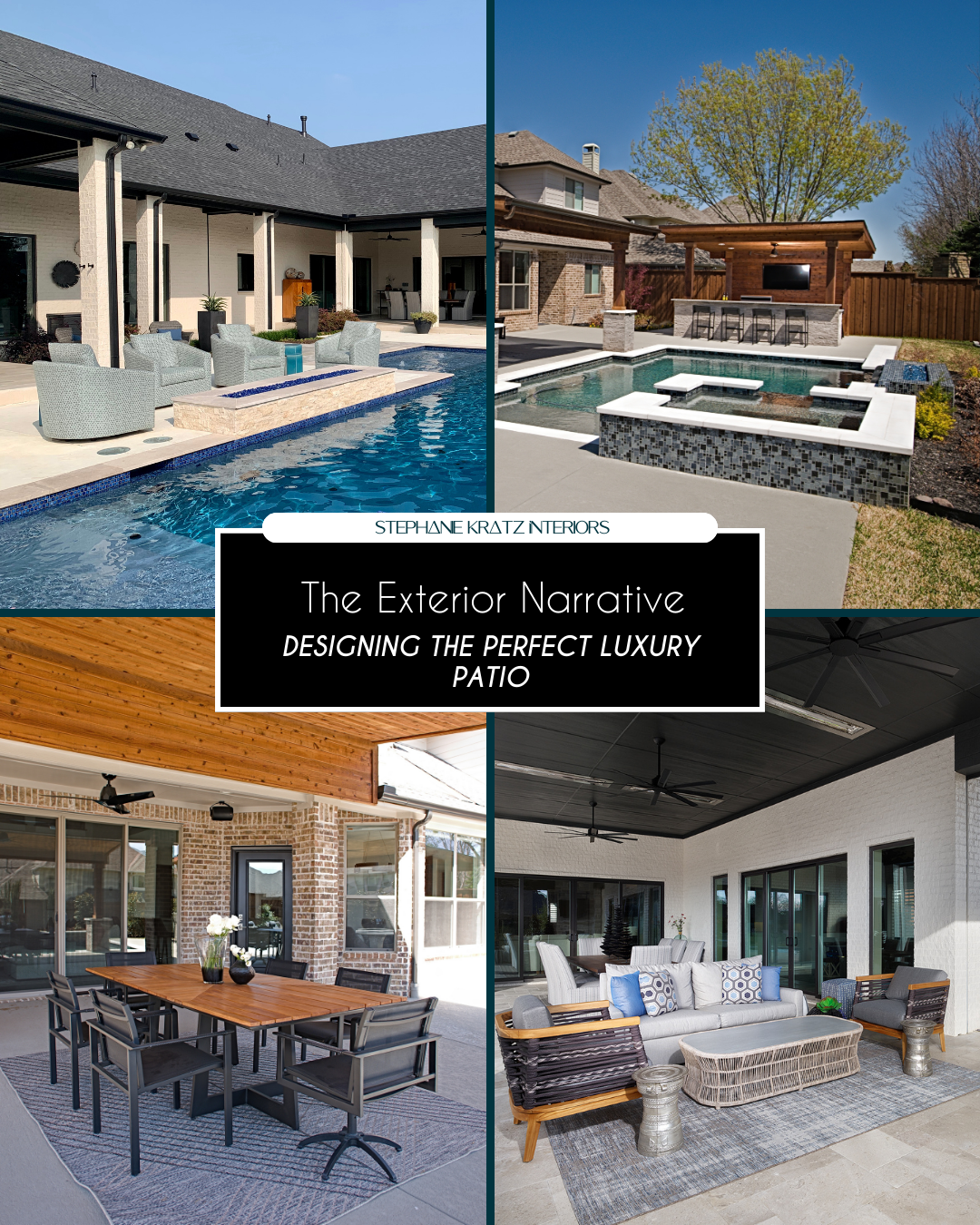
Quick Tips for the Perfect Patio:

  • Scale Up: Use larger furniture pieces than you think you need; small pieces get "lost" in the vastness of the outdoors.
  • Mixed Materials: Combine teak, stone, and metal to avoid a "showroom" look.
  • The "Nervous System" Check: Ensure your outdoor layout allows for decompression, with comfortable lounging that supports the human figure.


Ready to turn your backyard into a dream getaway?

Contact Stephanie Kratz Interiors today for a free consultation!


Book A Consultation!

Share This Post

By Stephanie Kratz April 15, 2026
Estimated Read Time: 3-4 minutes Key Takeaways: Think of art not just as wall covering, but as a crucial architectural and emotional layer of the room. Avoid the mistake of too small art. One massive, impactful piece often grounds a room better than scattered small frames. Look for 3D art textiles, plaster, or carved wood—to add depth that catches the light and adds sensory interest. Investing in Art for Your Legacy We believe that art is the single element that most profoundly tells your personal story in a home. While you can always swap out throw pillows or a rug, the art you choose to hang on your walls is a window into your soul. Too often, we see people choosing art solely to "match" a color palette. We urge our clients to see art as an emotional and architectural investment. Art isn’t decoration; it is the "High Touch" definition of your style that gives a room its true narrative and purpose. 3 Pillars of Art as an Architectural Investment The Power of Large Scale Scale is the most powerful tool for Expanding the Architectural Horizon. We frequently suggest to clients that they consider moving beyond the "gallery wall" of smaller works and instead consider investing in a single, commanding statement piece. A large scale work of art does not simply fill a space; it creates Architectural Depth and becomes the definitive Visual Anchor for the entire space. By selecting a work of art of similar scale to the space, you create a sense of Design Permanence, and it becomes a bold, simple choice with maximum impact. Adding Sensory Dimension Art in 2026 is moving beyond the flat canvas and into the world of the Tactile Revolution. Adding Sensory Dimension is looking at art pieces that have a physicality and a texture, like sculpted plaster, woven fibers, or even wood. The high touch surfaces play off the lighting in your home as the sun moves through the day, creating a "Living Sanctuary" effect. This is Sensory Engineering that makes your art not just something you look at, but something you experience. It adds a new level of "Organic Modernism" that blunts the edges of a room and makes you emotionally connect with your art. Off Center Architectural Balance True luxury can be found in the unexpected. Though symmetry is the historical norm, we adore the opportunity to apply off center architectural balance to provide a more modern and sophisticated circulation pattern. Placing a large piece of art slightly off center, perhaps paired with a sculptural floor lamp or a low custom bench, provides a "Dynamic Narrative" that leads the eye throughout the space. This application of off center balance disrupts the "Expected Grid" of a space and provides a more curated and "Boutique Luxury" aesthetic. It is a thoughtful design application that suggests a fashion forward sensibility, proving that the concept of balance is really about "Spatial Integrity."
By Stephanie Kratz April 8, 2026
Estimated Read Time: 3-4 minutes Key Takeaways: Think of your windows as the extension of your walls. The right drapery can make a low ceiling feel tall and a cramped room feel expansive. Use heavy velvets to "cozy up" a large, cold room or light linens to add movement and breeziness to a smaller space. Treat your windows as the frame for your "personal narrative." Curtains are not decoration; they are the architectural definition of your style. The Underrated Power of Curtains We often spend so much time thinking about the main pieces in a room, the sofa, the art, the rug. But we often overlook the frame that holds it all together. To us, curtains are not just a decorative finish; they are the essential "architectural jewelry" that tells you what the room is supposed to feel like. At Stephanie Kratz Interiors, we view drapery as a structural tool to define space and soften the hard lines of your windows. A room without well styled curtains feels unfinished because it’s missing that final layer of intention and "High Touch" comfort that turns a house into a true sanctuary. 3 Pillars of Architectural Window Design Expanding the Architectural Horizon We see curtains as something far more than merely a window treatment, but rather as a spatial tool used to influence the way you see your space. We don’t merely ‘hang’ our curtains, we incorporate them. In doing so, we are Expanding the Architectural Horizon, moving the boundary of the ‘Fifth Wall.’ It’s a design approach that makes any ceiling seem higher, any space seem more expansive. We are going well beyond the functionality of privacy or light control, instead using the space created by the horizontal and vertical lines of the drapes to provide the essential ‘Visual Anchor.’ That’s the idea behind Design Permanence: making a choice that fundamentally alters the way the space exists, rather than merely the way it appears. Defining the Sensory Mood When we design the 'Feel' of a sanctuary, we consider the windows. In high performance design, you don't have to choose one or the other; you get to design the ambiance. We enjoy designing with Sheer Layers behind another, more defined window treatment to give our clients absolute control over their space. This, my friends, is Atmospheric Engineering. You can filter the natural light in the morning to create a soft, inviting, and minimally stimulating glow. In the evening, you can close the heavy curtains to create a cozy, 'Lounge' ambiance, reminding you it's time to disconnect. The way light behaves with your curtains will set the Defining Sensory Mood of your space every waking hour. Adding Tactile Integrity A truly finished space has a physical, tactile feel. If a space feels "cold," "sterile," or "empty," it’s probably because it’s missing the soft architectural finish that well-layered curtains bring. In 2026, we are in the midst of a Tactile Revolution, and curtains are the ultimate tool. It’s not just about "softening the hard lines" of the window. It’s about adding Tactile Integrity to the entire space. The weight of the fabric, the texture of the Belgian linen or the opulence of the velvet, adds an organic contrast to the unyielding hardness of the architecture. It adds the final, high touch finish to the space, making the house less a structure and more a true "Social Sanctuary."
By Stephanie Kratz April 1, 2026
Estimated Read Time: 3-4 minutes Key Takeaways: Use a mix of high end linens and plush throws to create a "cloud-like" bed that simulates a 5-star hotel. Provide a "hospitality tray" with essentials like water, snacks, and the Wi-Fi code to make guests feel immediately at home. Use soft lighting and subtle scents to create a restorative atmosphere that encourages true relaxation. Designing the Ultimate Guest Sanctuary We think a guest bedroom should be so much more than just a place for someone to lay their head at night; we think it should be a destination within your home. At Stephanie Kratz Interiors, we specialize in the design of guest suites, and we call our process "Restorative Luxury." It’s the art of designing a space that feels like a high-end hotel, but is infused with the soul and character of your personal style. When you design a space for your guests, you're not just providing them a place to sleep; you're providing them a sanctuary where they can actually relax and unwind. 3 Essentials for a 5-Star Guest Sanctuary The Layered Bedding Experience True comfort can be found within the realm of the Tactile Integrity of your linens. We can go beyond the comforter and provide a "Visual and Physical Weight" to signal to the brain that it's time to sleep. This can be accomplished with a high-thread-count cotton or linen foundation, a medium-weight duvet for structure, and a textured throw to place at the foot of the bed to add a contrasting organic element. This is not just about aesthetics; it's Sensory Engineering to give your guests the opportunity to control their microclimate for a restful night's sleep. Curated Hospitality Details We think that luxury is a state of being awaited. Building a "First Ten Minutes" experience is all about delivering the High Touch basics ahead of a guest ever having to ask. Think of this as a Boutique Luxury setup. It includes a luggage area to keep the room flowing, a bedside water service, and a small tray for their personal items. With these small, yet significant "Social Anchors," a basic room is transformed into a personal sanctuary that is on par with a five-star resort. Low Stimulus Lighting Design Lighting is the final layer of Atmospheric Engineering , moving from bright overheads to warm, low level glow that settles the nervous system at sunset.
More Posts