Designing Your Legacy

Stephanie Kratz • November 5, 2025

Estimated Read Time: 3 minutes


Key Takeaways:

• Luxury interior design in 2025 is more about authentic personal expression than generic trends.

• Bespoke elements like custom millwork reflect individual lifestyles, routines, and passions.

• Curate meaningful possessions instead of simply accumulating them.

• Your home should tell your unique story.

• Design should enhance functionality and daily living and still look beautiful.


LIVInG BeYOnD aeSTHeTICS, CUSTOM MILLWORK, CURaTeD COLLeCTIOnS, SIGnaTURe FUnCTIOnaLITY

At Stephanie Kratz Interiors, we are eager to share our insights on the profound shift towards Bespoke Personalization & Narrative-Driven Interiors. Its been a topic that’s truly defining luxury design in 2025 as we move past the "algorithmic," mass produced luxury home. A truly exceptional residence is your living autobiography and meticulously crafted space that echoes your unique story, travels, passions, and dreams. This is beyond beautiful aesthetics, it's about authentic expression, where every design choice is a reflection of you and an investment in your legacy.


4 Features of a Personalized Home:

Custom Millwork & Built-Ins: tailored to perfection, merging beauty with functionality.

From a hidden reading nook integrated into a library wall to bespoke cabinetry designed around a specific collection, these elements are uniquely designed for your lifestyle and routines.


Curated "Maximal Minimalism": This isn't an oxymoron! It's the art of selecting meaningful objects.

A cherished art collection, artifacts from global adventures, family heirlooms and displaying them with intention and grace, allowing each piece space to breathe and tell its story without clutter.


Personalized Functionality: We design not just for how a space looks, but for how you live.

This means custom solutions for your daily rituals, be it a dedicated tea ceremony corner, a personalized dressing room, or a smart kitchen designed for your specific culinary journey.


Authentic Materiality: The materials themselves often tell a story.

Reclaimed wood with visible history, hand-troweled plaster walls with subtle imperfections, or stones chosen for their unique geological narrative.
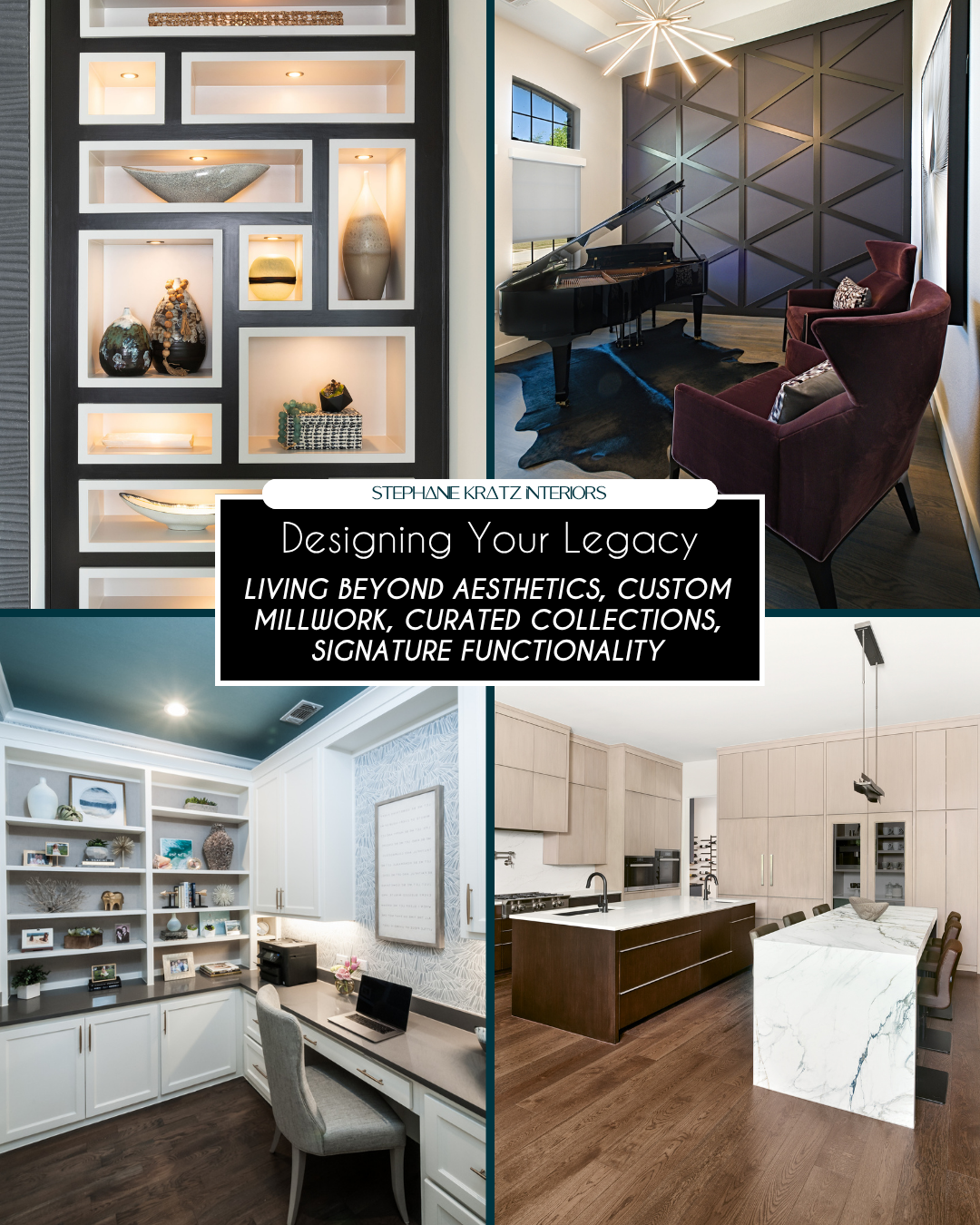

Design/image credit to @stephaniekratzinteriors

Your home should evoke emotion, inspire creativity, and serve as a profound reflection of who you are and what you hold dear. This narrative approach allows us to craft an environment that is not just visually stunning, but deeply meaningful and utterly irreplaceable. It’s an investment in your wellbeing, legacy, and daily delight. Let's craft an environment that doesn't just house your life, but celebrates it!


Ready to bring your unique story to life through exceptional design? Contact Stephanie Kratz Interiors today and schedule a free consultation!
Book A Consultation!

Share This Post

By Stephanie Kratz April 8, 2026
Estimated Read Time: 3-4 minutes Key Takeaways: Think of your windows as the extension of your walls. The right drapery can make a low ceiling feel tall and a cramped room feel expansive. Use heavy velvets to "cozy up" a large, cold room or light linens to add movement and breeziness to a smaller space. Treat your windows as the frame for your "personal narrative." Curtains are not decoration; they are the architectural definition of your style. The Underrated Power of Curtains We often spend so much time thinking about the main pieces in a room, the sofa, the art, the rug. But we often overlook the frame that holds it all together. To us, curtains are not just a decorative finish; they are the essential "architectural jewelry" that tells you what the room is supposed to feel like. At Stephanie Kratz Interiors, we view drapery as a structural tool to define space and soften the hard lines of your windows. A room without well styled curtains feels unfinished because it’s missing that final layer of intention and "High Touch" comfort that turns a house into a true sanctuary. 3 Pillars of Architectural Window Design Expanding the Architectural Horizon We see curtains as something far more than merely a window treatment, but rather as a spatial tool used to influence the way you see your space. We don’t merely ‘hang’ our curtains, we incorporate them. In doing so, we are Expanding the Architectural Horizon, moving the boundary of the ‘Fifth Wall.’ It’s a design approach that makes any ceiling seem higher, any space seem more expansive. We are going well beyond the functionality of privacy or light control, instead using the space created by the horizontal and vertical lines of the drapes to provide the essential ‘Visual Anchor.’ That’s the idea behind Design Permanence: making a choice that fundamentally alters the way the space exists, rather than merely the way it appears. Defining the Sensory Mood When we design the 'Feel' of a sanctuary, we consider the windows. In high performance design, you don't have to choose one or the other; you get to design the ambiance. We enjoy designing with Sheer Layers behind another, more defined window treatment to give our clients absolute control over their space. This, my friends, is Atmospheric Engineering. You can filter the natural light in the morning to create a soft, inviting, and minimally stimulating glow. In the evening, you can close the heavy curtains to create a cozy, 'Lounge' ambiance, reminding you it's time to disconnect. The way light behaves with your curtains will set the Defining Sensory Mood of your space every waking hour. Adding Tactile Integrity A truly finished space has a physical, tactile feel. If a space feels "cold," "sterile," or "empty," it’s probably because it’s missing the soft architectural finish that well-layered curtains bring. In 2026, we are in the midst of a Tactile Revolution, and curtains are the ultimate tool. It’s not just about "softening the hard lines" of the window. It’s about adding Tactile Integrity to the entire space. The weight of the fabric, the texture of the Belgian linen or the opulence of the velvet, adds an organic contrast to the unyielding hardness of the architecture. It adds the final, high touch finish to the space, making the house less a structure and more a true "Social Sanctuary."
By Stephanie Kratz April 1, 2026
Estimated Read Time: 3-4 minutes Key Takeaways: Use a mix of high end linens and plush throws to create a "cloud-like" bed that simulates a 5-star hotel. Provide a "hospitality tray" with essentials like water, snacks, and the Wi-Fi code to make guests feel immediately at home. Use soft lighting and subtle scents to create a restorative atmosphere that encourages true relaxation. Designing the Ultimate Guest Sanctuary We think a guest bedroom should be so much more than just a place for someone to lay their head at night; we think it should be a destination within your home. At Stephanie Kratz Interiors, we specialize in the design of guest suites, and we call our process "Restorative Luxury." It’s the art of designing a space that feels like a high-end hotel, but is infused with the soul and character of your personal style. When you design a space for your guests, you're not just providing them a place to sleep; you're providing them a sanctuary where they can actually relax and unwind. 3 Essentials for a 5-Star Guest Sanctuary The Layered Bedding Experience True comfort can be found within the realm of the Tactile Integrity of your linens. We can go beyond the comforter and provide a "Visual and Physical Weight" to signal to the brain that it's time to sleep. This can be accomplished with a high-thread-count cotton or linen foundation, a medium-weight duvet for structure, and a textured throw to place at the foot of the bed to add a contrasting organic element. This is not just about aesthetics; it's Sensory Engineering to give your guests the opportunity to control their microclimate for a restful night's sleep. Curated Hospitality Details We think that luxury is a state of being awaited. Building a "First Ten Minutes" experience is all about delivering the High Touch basics ahead of a guest ever having to ask. Think of this as a Boutique Luxury setup. It includes a luggage area to keep the room flowing, a bedside water service, and a small tray for their personal items. With these small, yet significant "Social Anchors," a basic room is transformed into a personal sanctuary that is on par with a five-star resort. Low Stimulus Lighting Design Lighting is the final layer of Atmospheric Engineering , moving from bright overheads to warm, low level glow that settles the nervous system at sunset.
By Stephanie Kratz March 25, 2026
Estimate Read Time: 3-4 minutes Key Takeaways: Use a gender neutral master palette to bridge different aesthetic preferences. Balance structural lines with soft textures to establish a shared mood. Repeat finishes like metals and wood tones to create a "visual thread" through the home. Focus on flow and lighting consistency to ensure the space feels like a unified sanctuary. Designing a Shared Sanctuary for Two When you think about nice homes a great house is more than just a bunch of beautiful rooms. It is a story that the people who live there tell together. Designing a home for two people, a man and a woman means finding a balance between what they like. This is not just about what one person wants. About making a home that feels right for both of them. The idea is to make a home that's not just nice to look at but a special place where both people feel happy and comfortable. In this home every part of the design works with every other part and it all feels very thoughtful and put together. Interior design for a high end home like this is about making a home that is a great place for the people who live there a home that is like a haven, for both partners, where every detail of the interior design of the home speaks to the other in a really nice way and that is what makes the interior design of the home really special. At Stephanie Kratz Interiors we really think about how to make a home feel like it belongs to both people who live there. We want the home to feel truly like both of them without giving up anything that makes it nice and stylish. We are talking about Stephanie Kratz Interiors. How we do this at Stephanie Kratz Interiors. 5 Strategies for Seamless Design Harmony Define a Gender Neutral Master Palette We call this style Organic Modernism. This way our space will not be too plain or too fancy. The idea of Organic Modernism helps us make decisions that work well together and create a look. This means that every choice we make will contribute to our vision of Organic Modernism. Establish a Shared Signature Style We want to find a style that we both like. Before we start looking at things we need to figure out what kind of mood we want to create. We do this by mixing lines, which are often thought of as masculine with softer curves, which are often thought of, as feminine. Repeat Key Materials & Finishes We should use the materials in different rooms to make the house feel connected. If the kitchen has blackened steel accents we can use that material in the lighting fixtures in the master bedroom. This way the whole house will feel like it belongs together. We can do the thing with the wood tone in the Great Room. If we use a walnut wood tone there we can use it again in the custom millwork in the study. This will help tie the house together and make it feel like one story. We are repeating the Key Materials and Finishes to create a connection, between the rooms. The Key Materials and Finishes are important to make the house feel like home. Optimize Sightlines for Collaborative Flow To make a space work well for two people we look at how they can move in it together. We make sure the doors are lined up and the floors connect smoothly so people do not have to stop. We put furniture in a way that helps people talk to each other and have shared experiences. This way no part of the space feels like it is, for one person. We want the Sightlines to be good so people can move around easily. Work together. By doing this we can make the space feel more open and help people collaborate. The Collaborative Flow is important so we make sure the space is set up to help people work together and move around easily. Curate Consistent Lighting & Ambiance To make a house feel like a home you need to get the lighting right. This means the lighting in each room should be consistent. For example a study needs lighting so you can see what you are doing and a dressing room needs bright lights so you can see yourself clearly.. The lighting in each room should be similar in quality. That is why we use things like dimmers to control the lighting and the feeling in the room. This way the house can easily change from a place where everyone is doing things together during the day to a quiet and relaxing place, in the evening just by touching a button. This helps make the house feel cozy and comfortable which is what makes it feel like a home.
More Posts